The NYC Non-Dilutive Grant Playbook: How to Win $10,000 to $50,000 from Local Business Competitions
Did you know New York City entrepreneurs can compete for tens of thousands of dollars in startup funding and sometimes before their businesses have generated meaningful revenue?
Across New York City, organizations run business plan competitions and startup challenges that provide founders with non-dilutive capital, training, mentorship, and other resources. Some are specifically designed for aspiring entrepreneurs and very early-stage businesses, while others expect applicants to have tested their idea, developed a product, or generated some initial traction.
That distinction is important because winning one of these competitions is not simply about having the most polished business plan or impressive financial projections.
It starts with alignment.
What is the organization behind the competition trying to fund? Does your company fit that mission? Are you solving a problem that matters to enough people? Is there evidence that customers actually want your solution? And if your company has not launched yet, can you demonstrate a realistic path from an idea to an operating business?
Then comes another challenge: can you communicate that vision clearly enough that judges understand it, believe in it, and want to support it?
For New York founders looking for capital without immediately giving up equity, understanding how these competitions work, and what they are actually looking for, can open another path to funding their businesses.
Can You Get a Business Grant in NYC If You Haven't Launched Yet?
In some programs, yes.
You do not necessarily need years of operating history, significant revenue, or an established company to compete for startup funding in New York City.
Some competitions are specifically designed to help aspiring entrepreneurs turn an idea into a functioning business.
Brooklyn Public Library's PowerUP! Business Plan Competition, for example, is designed for aspiring entrepreneurs and early-stage businesses in Brooklyn. The program combines business education with a competition offering cash awards.
The New York Public Library's New York StartUP! Business Plan Competition has also historically focused on businesses in the startup phase. Under its most recently published requirements, eligible businesses had earned less than $10,000, making the program accessible to founders with very limited operating history. NYPL notes that details for its next competition are still being developed, so founders should verify the new requirements when they are released.
Other competitions expect more evidence that the founder has moved beyond the idea stage. The Queens Tech + Innovation Challenge, for example, requires applicants to demonstrate either sales or evidence that the startup idea has been tested through customer or user feedback.
This creates an important lesson for pre-revenue founders:
If you don't have revenue yet, you need another way to demonstrate that the opportunity is real.
That evidence could come from customer interviews, prototypes, pilot programs, pre-orders, letters of interest, partnerships, waitlists, user testing, or other indications that people actually want what you intend to build.
A founder without revenue can still have a compelling case. A founder without revenue, validation, or a credible execution plan has a much harder one.

Business advisors reviewing a plan to use grant funding for inventory, hiring, equipment, technology, and operations.
Winning Starts With Alignment, Not the Application
Before completing a lengthy application or building a pitch deck, founders should answer a more fundamental question:
Why does this particular organization want to fund businesses like mine?
Every competition exists for a reason.
Some programs are designed to encourage entrepreneurship within a particular borough. Others want to support technology companies, neighborhood businesses, students, climate solutions, underserved founders, or companies capable of creating jobs and economic activity.
That mission should influence which competitions you pursue.
Consider the differences.
Brooklyn Public Library's PowerUP! program is designed around helping aspiring and early-stage entrepreneurs develop businesses in Brooklyn.
The Queens Tech + Innovation Challenge focuses on early-stage businesses with a connection to Queens and organizes its competition around areas including consumer technology, enterprise technology, sustainability, community, and food.
The Urban Future Prize Competition is much more specialized. It focuses on market-ready climate-tech startups developing scalable solutions related to climate mitigation and adaptation.
These organizations are not looking for exactly the same company.
A founder could have an excellent business and still be a poor fit for a particular competition.
Before applying, research the organization behind the award, its mission, eligibility requirements, judging criteria, previous winners, industries of interest, and the outcomes the program is trying to produce.
Then ask:
Does what they want to fund align with what we are building?
That should happen before you spend significant time preparing the application.
The Problem You Solve Has to Matter
Once you've established alignment, you still need to demonstrate why your business deserves attention.
This is where founders sometimes make the mistake of spending too much time describing their product and not enough time explaining the problem.
Judges need to understand:
Who has this problem?
How significant is it?
How are people dealing with it today?
Why are existing solutions inadequate?
How many potential customers experience the problem?
Why is your solution meaningfully better or different?
And most importantly: is the problem important enough that people will actually change their behavior or spend money to solve it?
A compelling application makes the problem tangible.
If you are building a product for small businesses, demonstrate the time, money, or opportunity those businesses lose because of the existing problem.
If you're opening a neighborhood business, demonstrate the unmet demand within the community and why your concept fills it.
If you're developing climate technology, explain both the commercial problem and the potential environmental impact.
Urban Future, for example, specifically asks applicants to articulate the potential sustainability impact of their core product or service.
The objective isn't to make your problem sound enormous.
It's to make it real, understandable, and important.
If You Don't Have Revenue, Show Evidence
An operating company has evidence that a brand-new startup doesn't.
It has customers.
It may have recurring revenue, retention data, margins, contracts, or years of operating history.
A founder who hasn't launched cannot point to those things. But that doesn't mean the founder cannot build a credible case.
It means the evidence has to come from somewhere else.
Suppose you're developing a physical product. Have potential customers tested a prototype? Have you received pre-orders? Do you have manufacturing quotes? Do you understand your cost per unit and the price customers are willing to pay?
Suppose you're starting a service company. Have you interviewed prospective customers? Have potential clients expressed interest? Do you understand what they currently pay for alternatives? Does your team have experience solving the problem?
Suppose you're developing technology. Have you built a prototype or minimum viable product? Have users tested it? What did you learn? Did those findings change the product?
This is why customer validation matters.
A founder saying, “I believe people need this,” is making an assumption.
A founder saying, “We interviewed 50 potential customers, 35 identified this as a significant problem, 12 tested our prototype, and six have agreed to participate in a pilot,” is presenting evidence.
The second story is much easier to believe.
Can You Actually Get the Business Off the Ground?
A strong idea is not necessarily a viable business.
For an early-stage founder, one of the most important questions is whether there is a believable path from where the company is today to an operating business.
If you receive $20,000, what happens next?
What will you build?
Who needs to be hired?
What equipment or inventory needs to be purchased?
How long will development take?
How will you acquire your first customers?
What milestones should the company reach with the funding?
What happens after the grant money is spent?
This is where a business plan and financial model become important—but they are supporting evidence, not the entire story.
Financial projections should demonstrate that the founder understands how the business works.
If you project $500,000 in sales, where will those customers come from?
If your product sells for $100, what does it cost to produce and deliver?
If you're hiring three people, can the business realistically support their salaries after the grant funding runs out?
Numbers become persuasive when the assumptions underneath them make sense.
The purpose of the financial model isn't to predict the future perfectly. It's to demonstrate that the founder has thought seriously about what it will take to turn the opportunity into an operating business.
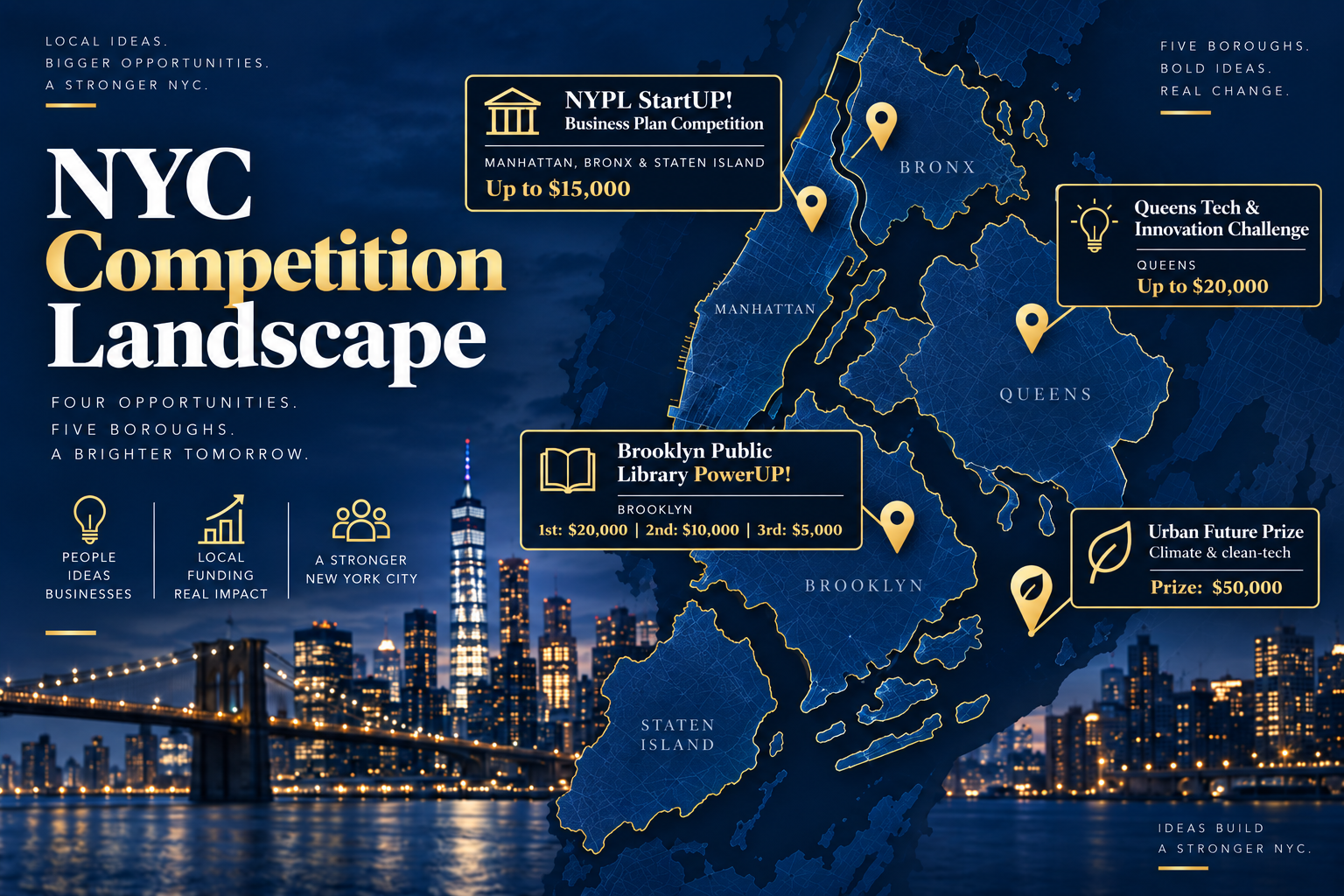
Map of NYC grant competitions including Brooklyn PowerUP!, NYPL StartUP!, Queens Tech and Innovation Challenge, and Urban Future Prize.
Your Vision Has to Be Something People Can Understand and Believe In
There is another part of winning competitions that is easy to underestimate:
Communication.
Judges may evaluate dozens or even hundreds of businesses.
A founder can have an excellent concept and still lose the room if nobody can understand what the company does, why it matters, or how it becomes a viable business.
A strong pitch should make five things clear:
This is the problem.
This is who experiences it.
This is how we're solving it.
This is why we believe the solution can work.
This is what your funding will allow us to accomplish next.
The objective isn't to pack the presentation with technical terminology, market-size statistics, or complicated financial charts.
It's to create a vision that another person can understand and eventually repeat to someone else.
That matters because competitions aren't purely mathematical exercises. At some point, people have to believe in the founder, the opportunity, and the path forward.
Brooklyn Public Library PowerUP! Business Plan Competition
For aspiring and early-stage Brooklyn entrepreneurs, the Brooklyn Public Library's PowerUP! Business Plan Competition is one of the city's most established business competitions.
The program combines business education with a formal business plan competition. Current prizes include $20,000 for first place, $10,000 for second place, and $5,000 for third place. Applicants must meet the program's Brooklyn residency and library-card requirements, among other eligibility rules.
What makes PowerUP! particularly relevant for new founders is that applicants don't need to arrive with a mature company.
The program itself includes business-planning education designed to help participants develop their concepts.
What should a founder take from that?
Don't assume being early automatically makes you uncompetitive.
Instead, use the process to demonstrate how seriously you've investigated the opportunity. Show that you understand your customer, economics, competition, operating requirements, and what it will actually take to launch.
Brooklyn Public Library PowerUP! Business Plan Competition
NYPL New York StartUP! Business Plan Competition
The New York Public Library's New York StartUP! Business Plan Competition has provided another path for very early-stage founders.
Under the most recently published program requirements, the competition was open to eligible businesses in Manhattan, the Bronx, and Staten Island that were in the startup phase and had earned less than $10,000. Published prizes included $15,000 for first place, $10,000 for second place, and $7,500 for third place. NYPL says details for the next competition are still being developed.
The low-revenue requirement is important because it demonstrates that a lack of extensive operating history does not necessarily prevent a founder from competing.
It does, however, put more pressure on the founder to establish credibility elsewhere.
If there aren't years of financial statements to examine, the quality of the business concept, market research, customer strategy, financial assumptions, and execution plan becomes even more important.
NYPL New York StartUP! Business Plan Competition
Urban Future Prize Competition
For founders building climate and clean-technology companies, the Urban Future Prize Competition represents a more specialized opportunity.
The 2026 competition offers two $50,000 zero-equity grand prizes and two $10,000 runner-up awards, along with admission to the ACRE Incubator. The competition is designed for market-ready climate-tech startups, and applicants must meet requirements around company stage, fundraising, geography, and climate impact.
This is an important example of why alignment matters.
A strong consumer startup isn't necessarily a strong Urban Future candidate. The business needs to fit the competition's climate focus and demonstrate the potential sustainability impact of its core product or service.
For climate-tech founders, that means the pitch needs to connect three things:
the problem, the commercial opportunity, and the measurable climate impact.
The 2026 application period has closed, but founders working in this sector can use the program as an example of the type of specialized competition worth incorporating into future funding plans.
Urban Future Prize Competition
Don't Chase Every Competition
Once founders discover this ecosystem, another mistake becomes possible: applying to everything.
More applications do not necessarily create better odds.
A founder may be better served by identifying a smaller number of opportunities where there is genuine alignment and preparing exceptionally strong applications.
Before pursuing a competition, consider:
Eligibility: Do you actually qualify based on geography, stage, revenue, industry, and other requirements?
Alignment: Is this the kind of business the organization is trying to support?
Problem: Are you solving something significant enough to warrant attention?
Validation: What evidence demonstrates that customers actually want the solution?
Execution: Can you realistically build and grow the business?
Use of Funds: Can you clearly explain what the award will accomplish?
Communication: Can judges understand the opportunity quickly enough to believe in it?
If several of those answers are weak, the solution isn't necessarily to improve the application.
It may be to strengthen the business first.
Build the Business, Then Build the Application
Winning a startup competition begins long before a founder clicks “submit.”
You need to understand where your business fits, identify the problem you're solving, validate that people actually care about that problem, develop a credible path to market, understand the economics of your business, and communicate a vision other people can understand and support.
Those things matter whether you win a competition or not.
A founder who goes through that process properly should emerge with a stronger business—not simply a better pitch deck.
At Startup Advisory Group, our focus is helping entrepreneurs build and grow their businesses. We work with founders on business planning, strategy, operations, financial modeling, market positioning, and the practical work required to move an idea or early-stage company forward.
Pitch competitions and grant opportunities can be one part of that growth strategy. If you need help identifying the right opportunities, determining whether your business is ready, strengthening the underlying strategy, or navigating the competition process, our team can help.
Learn more about Startup Advisory Group at startupadvisorygroup.co.